
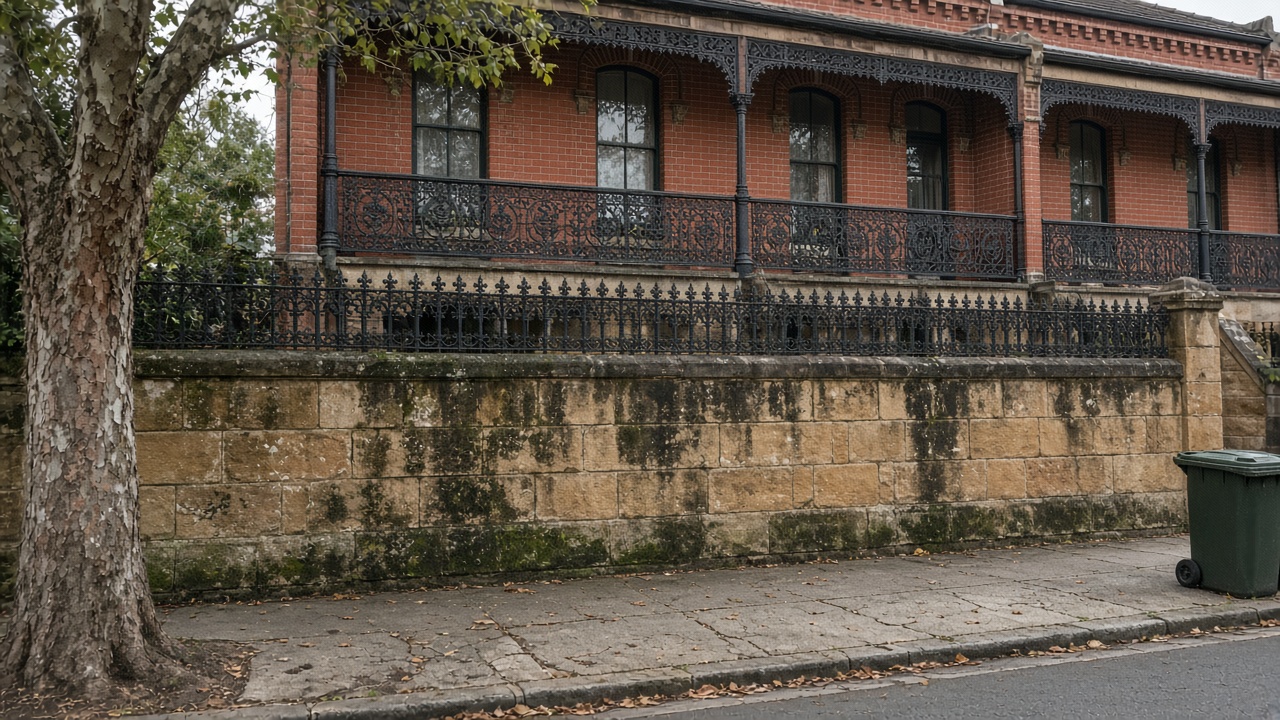
Façade cleaning on an older Sydney building is not a weekend pressure wash. Soft brick, sandstone, lime render and decorative plaster all respond differently to water, detergents and mechanical action. The useful question is not “how bright can we make it?” It is which soiling or biological growth is harming the fabric — and which method removes that load without abrading faces, driving salts deeper or opening failed joints to more weather.
This supporting /news guide sits under our façade restoration and repairs service. It explains assessment, heritage-safe methods, when cleaning alone is enough, and when repairs must come first. Sister articles cover power washing on heritage façades and rope-access façade cleaning. Related fabric decisions continue in render and plaster façade repairs and façade restoration and repairs in NSW.
What façade cleaning actually removes — and what it does not
Owners and strata often use façade cleaning for any of the following. Clarify which before comparing day rates:
Atmospheric soiling — traffic film, pollution deposits and general greying.
Biological growth — algae, lichen, moss and microbial films that hold moisture against the face.
Staining — rust runs, copper staining, paint overspray or graffiti (each needs a different trial).
Salt residues — white crystalline deposits that look like dirt but signal moisture and evaporative cycles.
Post-repair wash-down — removing mortar smears and construction dust after pointing or render work.
Cleaning does not fix open joints, cracked render, loose cornices or rising damp. Brightening a photograph while leaving weather paths open is poor conservation and usually a short-lived result. If white powder is the main symptom, start with efflorescence on brick and sandstone before assuming a detergent problem.
Why method matters more than a “clean look”
Heritage and older façades in Sydney and NSW face harbour salts, driving rain, pollution and decades of incompatible patches. Soft sandstone and soft historic brick can lose their weathered face permanently under high-pressure water or abrasive blasting. Dense cement repairs and impermeable coatings can look crisp while trapping moisture — cleaning over unresolved damp often returns as staining within a season.
Conservation-led practice prefers the gentlest effective method, trialled on a discrete panel and viewed dry as well as wet. SPAB-style caution against unnecessary abrasion applies as much to façades as to church stonework: retain sound surfaces; do not “renew” character by polishing it away.
Assess before you hire a cleaning crew
Before hoses and scaffolds appear, record what is present:
Fabric map — brick, sandstone, render, terracotta, painted timber, metals and previous coatings.
Defect map — open joints, hollow render, loose units, failed flashings, overflows.
Soiling type — biological, atmospheric, paint, salts, or mixed.
Moisture sources — gutters, ground build-up, rising damp, lateral wetting after rain.
Access and occupation — scaffolding, elevated work platforms, rope access, pedestrian management, strata notices.
Heritage controls — local listing, conservation area, State Heritage Register conditions.
Photograph elevations dry and after rain. Note areas that stay damp longest — they often need repair or drainage correction before cosmetic cleaning. A quote that jumps to “high pressure whole building” without trials is not a heritage method statement.
Heritage-safe cleaning methods (families, not slogans)
Method selection belongs in assessment. Common families include:
Controlled low-pressure water with soft brushes — useful for light biological growth on sound, hard surfaces when run-off is managed. Not a free pass for soft sandstone.
Nebulous or mist systems — finer delivery that can reduce impact on fragile faces when correctly specified.
Chemical poultices and gels — specialised clays or gels that hold cleaning agents against the surface to dissolve salts or pollutants without saturating the wall. Our façade restoration service notes poultice approaches for salt and pollution loads.
Biocide treatments — where biological growth is active and the substrate will tolerate the product; follow label and heritage advice.
Localised paint or graffiti removal — trials first; never assume one solvent suits sandstone, limewash and modern acrylic alike.
Hand tools and soft abrasives — only where fabric and evidence support them; avoid indiscriminate grit blasting on soft masonry.
What usually does not belong on soft historic masonry: high-pressure fan jets at close range, sandblasting that removes tooling marks, and acid washes used without trials. See power washing heritage façades for a fuller warning on aggressive pressure washing.
When cleaning should wait for repairs
Sequence matters. Cleaning first can be useful so defects are readable — but saturating a wall with open joints, hollow render or active salt crystallisation can worsen damage. Typical “repair first or alongside” situations:
Loose overhead masonry or failed cornices (making-safe before public cleaning access).
Failed pointing that will admit large volumes of wash water.
Hollow or debonded render that will blister under water load.
Active rising damp or overflow wetting that will re-soil the cleaned face.
Dense failed coatings that need careful removal trials rather than blasting.
Where both cleaning and fabric repair are required, agree which elevations are trials, which are weather-critical, and how wash water and salts will be managed. Staging suits occupied residential, strata and commercial buildings — a pattern already used on our façade restoration programmes.
Access: scaffolding, EWP and rope access
Street-facing Sydney façades often need more than a ladder. Scaffolding or elevated work platforms provide stable workfaces for detailed cleaning and concurrent repairs. Rope-access façade cleaning can reduce footprint on constrained sites when the method and safety systems suit the brief. Access is a cost and programme driver — not a free add-on. Ask how public protection, waste water and neighbour interfaces are handled before comparing “per square metre clean” rates.
Strata, commercial and heritage paperwork
Strata schemes need clarity on common-property façades, lot access notices and who authorises variations. Commercial street fronts often need pedestrian management and after-hours windows — price those into the programme. Heritage-listed buildings and conservation-area properties may need method statements and photographs for council; cleaning that abrades significant fabric can be a compliance problem as well as a conservation one. Confirm listing status before visible surface change.
Documentation that helps everyone: SWMS/JSA where required, trial panel photographs (before/after, dry), product data for any chemicals used, and a plain note of what was *not* cleaned because defects needed repair first.
What drives façade cleaning cost in Sydney
There is no honest single rate for every elevation. Cost moves with:
Extent — one street front, courtyards, full wrap; measured area versus gross wall.
Fabric and soiling — soft stone trials, paint removal, heavy biological load.
Method and materials — poultices, biocides, multiple passes, waste disposal.
Access — scaffold, EWP, rope access, traffic control.
Occupation — staging, after-hours, dust and water control.
Related repairs — pointing, render patches, making-safe discovered mid-clean.
A low square-metre figure that omits access, trials or run-off management is not cheaper once the true scope appears. Compare method statements and exclusions, not headline rates.
How a sound programme is usually sequenced
Assessment and recording — fabric, defects, soiling, moisture, access.
Trials — discrete panels; review dry after a weathering interval where practical.
Making-safe and weather-critical repairs as required.
Main clean — agreed method, protection of openings and neighbours, controlled run-off.
Post-clean inspection — newly visible defects, residual staining, salt bloom.
Follow-on repairs and handover — pointing, render, maintenance advice.
That sequence is what you are paying for when you engage façade restoration and cleaning in Sydney — not only a lighter photograph.
Maintenance after cleaning
Keep gutters and overflows clear. Watch for rapid re-soiling that signals a moisture path. Avoid dense DIY sealers on soft masonry as a default “protection” — they can trap moisture and salts. Soft brushing and timely minor repair usually cost less than waiting for a whole elevation to fail again. Record products used so the next contractor inherits a history.
Choosing a contractor without “near me” theatre
Queries such as façade cleaning Sydney and “building wash near me” find capacity. Locality helps logistics; it does not establish method. Prefer teams who name substrate-specific approaches, show trial panels, stop when the wall needs repair rather than more pressure, and document chemicals and access. Ask whether the same crew will touch soft sandstone the way they wash modern render — if the answer is “same lance, whole building,” keep looking.
Stoneline Heritage undertakes assessment-led façade restoration, repairs and heritage-sensitive cleaning across Sydney and NSW. Send wide elevation photographs plus close-ups (dry and after rain if you can), note access limits and heritage status, and ask for a method that covers diagnosis and trials — not only a start date.
Cleaning versus coating — why “seal after wash” is not automatic
After a successful clean, owners sometimes ask for a clear sealer “to keep it looking new.” On soft brick, lime render and many sandstones, dense coatings can trap moisture and push salt crystallisation to a worse plane. Protective treatments belong only where substrate, salts and exposure support them — and never as a substitute for fixing open joints or active damp. Our façade restoration approach treats coatings as a separate, evidence-based decision from cleaning.
If previous paint or acrylic finishes are failing, removal trials may be part of the cleaning brief. Do not assume high-pressure water will lift coatings evenly from soft stone without damage. Paint removal from sandstone has its own risks; coordinate with masonry advice rather than improvising solvents on a whole elevation.
Biological growth and Sydney’s microclimates
South-facing and shaded elevations in Sydney often hold algae and lichen longer than sun-baked street fronts. Courtyards, lane walls and elevations under dense trees re-soil faster if gutters overflow or ground levels stay wet. Cleaning without correcting those conditions buys a short interval of brightness. Note irrigation spray, air-conditioning condensate and planter boxes against walls — they are common re-soiling drivers that do not appear in a “wash quote” checklist.
Where lichen has penetrated soft stone texture, aggressive removal can take sound face with it. Prefer staged biological treatment and gentle mechanical aid over blasting to bare “new” colour. Character on older façades often includes an even, weathered tone; chasing a showroom white is rarely conservation-led.
Frequently asked questions
What is heritage façade cleaning?
Removing soiling, biological growth or pollution from an older façade using methods matched to the fabric — after assessing defects and moisture — rather than maximising brightness at any cost.
Will high-pressure washing clean my sandstone or soft brick safely?
Often no. Aggressive pressure washing can abrade soft masonry, open joints and drive salts deeper. See power washing heritage façades.
Is cleaning the same as façade restoration?
No. Cleaning addresses surface loads; restoration addresses failed fabric and weather paths. They often sit in one programme but answer different questions.
Do you need scaffolding for façade cleaning in Sydney?
Many street fronts and multi-storey elevations do. Rope access or EWPs may suit some sites. Access is part of the scope and the risk plan.
Can strata stage façade cleaning?
Yes. Staging by elevation or by making-safe / weather-critical zones is common on occupied buildings.
How do I start a quote?
Send clear photos, the address, access notes and what you have noticed. Expect assessment and trials before a firm clean scope.