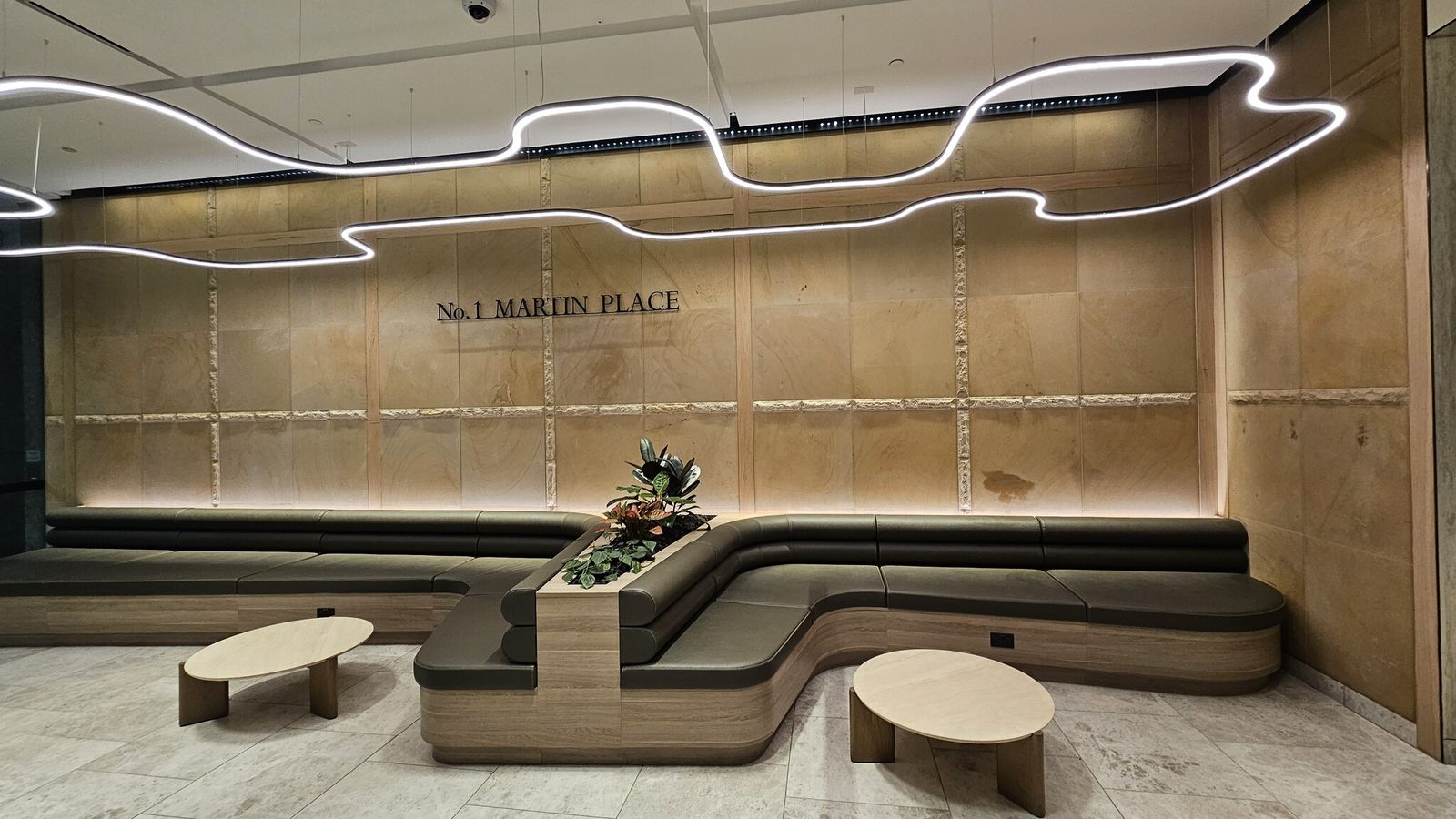
Historic sandstone in Sydney's CBD lives with traffic, construction dust and the city's air. Over time, high-traffic urban façades accumulate atmospheric pollution, soot, dust, surface staining and previous contamination. At No. 1 Martin Place those deposits sat on historic sandstone that still had to be treated as original fabric.
The project is Martin Place Sandstone Façade Cleaning: heritage sandstone cleaning and surface conservation, in Sydney's CBD. The work cleaned historic sandstone elements in a sensitive CBD setting where conventional high-pressure washing or aggressive cleaning was not suitable. The task was conservation — to lift soiling that could be lifted, without damaging the stone or adding unnecessary moisture to the substrate.
Why high-pressure washing was ruled out
Cleaning historic sandstone is a method problem before it is a labour problem. The stone is porous. A high-pressure jet can cut a weathered face, open the pores, and drive water, dissolved soiling and salts into the substrate instead of taking them off it. In a busy CBD setting the same approach also produces runoff that is difficult to control around public space and an occupied building.
High-pressure washing was therefore ruled out. So were other aggressive methods that treat the façade as something to be blasted clean. The deposits on urban sandstone are real, but they sit on original stone. Method selection has to avoid damaging that stone and avoid introducing unnecessary moisture into it.
That is the same rule used on other heritage façades: identify the surface and the soiling, then choose a method the stone can tolerate, rather than a method that produces a uniformly bright result.
How the waterless peel-off system was used
The team used a specialist waterless peel-off cleaning system. Paste was applied to the stone, allowed to bind with accumulated grime and contaminants, and then removed once cured.
The sequence is slower than a pressure lance, and that is the point. The paste does the holding. Grime is bound into the film and lifted with it, instead of being washed across the façade or forced into the pores. Because the system is waterless, it reduced the need for water, minimised runoff, and protected the porous sandstone substrate.
The objective was to clean the stone carefully while preserving its natural character, texture and appearance. Cleaning of this kind is not a cosmetic reset to a new-looking face. It is the removal of soiling that sits on the surface, so the sandstone can be read again as sandstone.
Method follows the surface, not a single recipe
Façade cleaning on heritage and older buildings is not one process. After assessment, the scope may include controlled low-pressure cleaning, specialist chemical cleaning, conservation poultices or waterless peel-off systems, depending on the surface and the deposits. The choice follows assessment and testing. One method is not suitable for every part of a building.
At Martin Place the peel-off system was matched to historic sandstone in a setting where water and pressure were liabilities. Other parts of a façade — a different condition of stone, a different deposit, a different adjacent material — may need a different treatment. Trial areas are how that is established: they show what the stone will accept and what a realistic cleaned result looks like before work is extended.
The same approach underpins façade cleaning for heritage buildings in Sydney. Pollution, dust and old contamination can hide architectural detail, but cleaning has to distinguish removable deposits from the surface and patina that give older masonry its character. High-pressure cleaning is not the default for heritage masonry.
Conserving fabric, not replacing the look
Sandstone at a building of this kind is historic fabric. Once the face is cut, over-cleaned or saturated, that loss is not recovered by a later finish. Work of this type belongs with sandstone and stone restoration: understand the substrate, select a compatible method, and keep as much original material as possible.
Cleaning is one part of that. It does not repair failed mortar or an ongoing moisture problem, and it is not a substitute for those repairs where they are needed. At No. 1 Martin Place the constraint was the setting as much as the stone — a sensitive CBD building, historic sandstone, and a need to clean without high-pressure washing or uncontrolled water. The peel-off system met that constraint: apply, bind, cure, lift, and leave the texture of the stone in place.
The Martin Place project sits with other conservation jobs on the projects listing. For buildings with similar soiling on sandstone or mixed masonry, the starting point is an assessment of the surface and a tested method, not a decision to wash the façade until it looks new.