Marble repair in Sydney is contractor work: assessing a damaged marble surface and returning it to a sound, even condition that suits the stone already in place. Cracks, chips that keep appearing, etching, stains that return, and marble on a stair, a facade or in a heritage interior should be assessed before the face is abraded. A local repair is sometimes enough, and often the sound scope is wider, because the mark and its cause are not the same thing. Stoneline Heritage carries out marble repair for homes and strata across Sydney and NSW, advises on suitability, and installs or repairs marble that the owner, architect or designer has selected and sourced.
When marble repair needs a contractor
A contractor should assess marble that may still be moving, that an earlier attempt has worsened, or that is original fabric, a stair, or part of the outside of a building.
Chips, cracks, etching, stains and repairs that have already failed
The mark is named before a method is chosen, because one word often covers several faults.
- Etch. A dull patch where acid has dissolved the surface. Citrus, vinegar, wine, tomato, some soft drinks and some cleaners do this. Wiping does not restore the stone.
- Stain. Colour in the pores, from oil, cosmetics, tea, coffee or rust from iron. One spill can leave both a stain and an etch.
- Scratch. A cut from grit, sand or a blade. It often catches a fingernail. An etch usually does not.
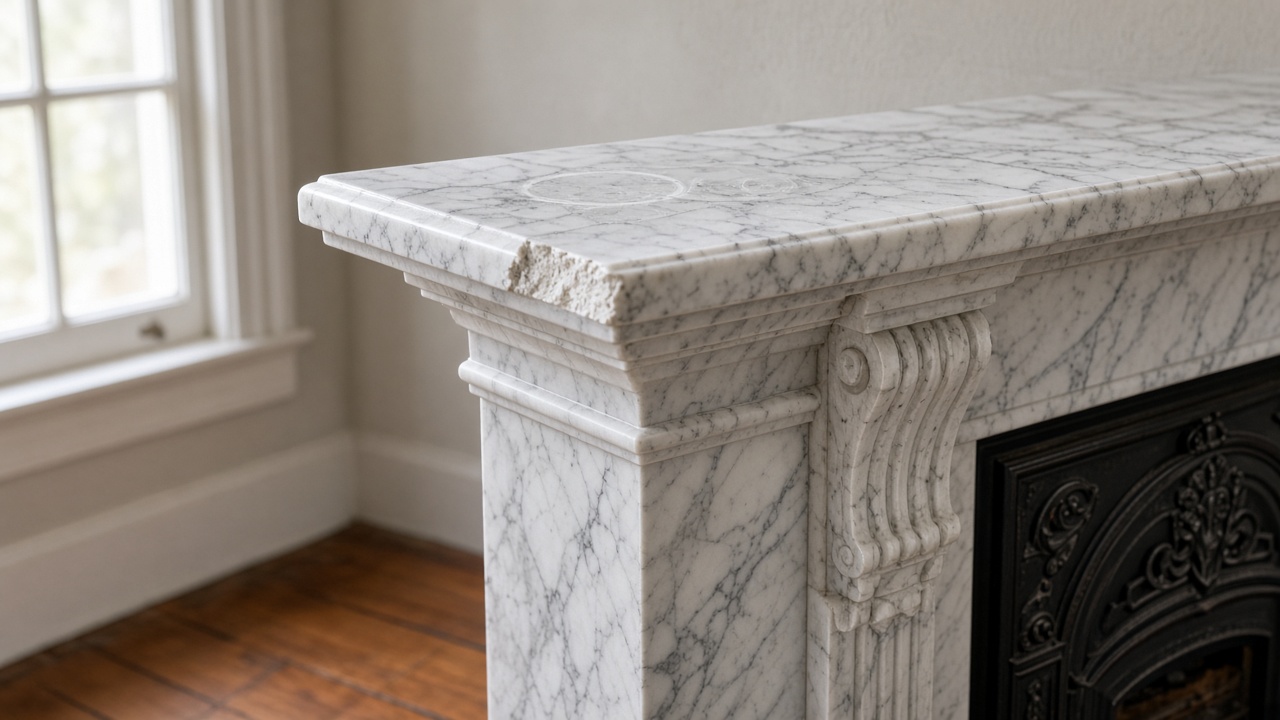
- Chip. Stone missing from an edge, a corner, an arris or a cut-out.
- Crack. A fracture, not a vein. A vein follows the pattern. A crack can break it and may grow if the piece moves or lacks support.
- Loss of polish. Even dulling from traffic, abrasive cleaners or many small etches.
- Lippage. One slab or tile proud of the next. A setting fault, which polish will not hide.
Chips that return on one edge usually mean impact, a thin arris or movement. A returning stain means the source is still there. A dark fill, a dull halo or an opened joint is a failed repair, and cutting it out enlarges the loss.
A search for a marble repair kit usually means a chip, a scratch or a dull patch. A kit does not identify the marble, the finish or the cause, and it will not show a moving crack. Stoneline Heritage does not provide kits. Ask for a site assessment so the repair matches the stone.
Benchtops, floors, stairs, wall linings and sills
Marble benchtop repairs are a common visit. To repair marble benchtop damage, etch, scratch and chip are separated. A corner crack at a sink or cooktop is read with the support under the top. If the slab moves, filler is not the remedy.
Floors show lost polish, lippage or hollow tiles. A tile can only be ground so far before it is too thin, so the bedding may need repair rather than another polish. That tiling is governed by AS 3958 tiling and the instructions for the setting materials.
Stair nosings take the wear underfoot, so the edge that remains has to be sound. A lining may sound hollow where a fixing has failed, and a sill chips at the front. Outside, a sill takes water at the frame. External marble is judged with its joints, fixings and weather.
Marble in a heritage interior or on a facade
Victorian and Federation houses often include a marble surround, hearth, threshold or washstand. The moulding is kept. Flattening it so a fill is easier removes the detail worth retaining. If the loss is too great, the owner, architect or designer sources the replacement and Stoneline Heritage installs it.
Stone Polishing on Heritage Work: When It Helps — and When It Does Not sets out when a refinish on older work helps and when it takes too much original surface. A high polish is often wrong on a honed surround.
Joints and restraints are checked before a facade chip is filled. A surface fill does not secure a loose panel. Where marble is part of the external wall, the scope sits with facade restoration. Fire, structural and waterproofing requirements, where the work touches them, are checked against the National Construction Code, the manufacturer's installation instructions and the project engineer or certifier.
What the assessment covers
The assessment is made on the stone, not from a photograph alone. It names the material and the finish, looks for the cause, and sets the scope. Not every mark can be made to vanish.
Stone, finish and any coating already on the surface
Marble is largely calcium carbonate, so acids etch it. Colour and vein are noted, because two slabs of the same name can differ. The stone already in place is the one to judge, unless it is beyond repair.
A polished face shows etches and a resin fill in raking light. A honed face is matt, so an etch is quieter, but a shiny patch still stands out. The finish already there is the one to match.
Wax or an impregnating sealer can mimic an etch or hide one, so it is identified before abrasive work. If a sealer goes on afterwards, the owner, architect or designer selects and sources it. Stoneline Heritage does not provide sealers.
Likely cause, including water, heat and movement
Water at sinks, showers and failed joints carries stains into the pores. A stain that returns is a reason to look for a leak. In a wet room the junction with the wall or tray matters as much as the face.
Heat at a cooktop or hearth is checked where a crack leaves a cut-out, together with the support around that opening. The crack is not assumed to be a chip, and a hearth moulding is left intact.
A rocking slab, a hollow tile, a dropped stair or a shifted panel will keep a crack working. Lippage is a setting fault. Filler will not stop movement. The contractor says when joinery, structure, waterproofing or the project engineer has to be involved.
Whether a local repair is sound, or the scope needs to be wider
A local repair suits stable stone and a cause that has stopped. A modest chip in even marble, away from a moulding, is the usual case. The fill may remain visible if the edge is sound and the profile is true.
If only the worst of a dull top or floor is polished, that patch sits as an island of different sheen. One honed finish across the face is often the compatible scope, with a higher polish only where the original face supports it. A deep scratch treated in a small circle shows as a dish.
A crack through a slab, a chipped moulding, hollow tiles, open lippage or a failed earlier fill also widen the work. If the piece cannot be filled or pieced, it is replaced with marble the owner, architect or designer has selected and sourced.
How a contractor carries out marble repair
Protection comes first, then a repair matched to the defect, then a check after curing. An etch, a chip and a loose panel are not the same task. This is not a home method.
Protection of the surrounding surfaces, then the repair itself
Joinery, floors and nearby stone are protected, and the scope names the rooms affected. Where marble meets sandstone, slurry is kept off the sandstone.
An etch is refinished, not filled. A chip is filled or pieced so the profile returns. A joint refill will not hold a moving crack. If the slab is past repair, the contractor installs marble the owner, architect or designer has selected and sourced.
Colour and polish matched as closely as that marble allows
Resin and stone reflect light differently, so a close tint can still show where a vein crosses the loss. The tint is trialled on the piece in daylight before the wider face is committed.
The polish matches the finish already there. A glossy patch on a honed top still looks repaired. Sandstone Polishing in Sydney: Finish Choices That Respect the Stone makes the same point for sandstone. What will remain visible is said before work is agreed.
What the client can expect on site: access, dust control, time to cure
The scope covers access, including lifts and stairs, when work can proceed, and which rooms will be out of use. In a home, benches are cleared, joinery is masked, and dust is contained. On a common stair, floors are covered so people can pass.
A fill or piece cures before it is levelled and returned to use. The time depends on the material, so the scope states it. The surface stays out of service until colour, profile and sheen are checked.
Materials and methods
The aim is the least work that leaves the piece sound, with original marble kept where it is still reliable.
Fillers and piecing chosen to suit the marble, not a single product for every job
A tinted filler replaces volume in a modest chip or a narrow joint. It does not rebuild an etch or lock a moving crack. The tint is made for that stone, and a vein, or a shift from white to grey, may still show.
Piecing sets marble into a larger loss or a moulded edge so the profile continues. It suits a broken arris, a nosing or a surround. The owner, architect or designer selects and sources any new marble. Stoneline Heritage advises on the match and installs it. Loose panels and hollow tiles are a fixing question, not a filler question.
Keeping original marble wherever it is still sound
Sound original marble stays, including stone that is honestly worn, because a later piece rarely continues the vein. Replacement is for a fractured slab, a piece that cannot be pieced, or a loose panel that cannot be refixed. A repair that will show slightly is not, by itself, a reason to replace.
The assessment marks what stays untouched. Any new piece has to meet the marble around it. Interior architectural marble and wall linings are carried out as sandstone and stone restoration.
Sydney and NSW considerations
Strata access, heritage controls, salt air, wet rooms and sun change the scope even when the mark does not. Stoneline Heritage works in Sydney and NSW only. What marble repair Sydney homes and strata buildings need is an assessment on site.
Strata common property, access and the owners corporation
Lobbies, stairs, shared bathrooms and external walls are often common property. A benchtop inside a lot usually is not. This page is not legal advice. The contractor will flag when strata approval may be needed. Whether the owners corporation needs to approve the work is for that corporation to decide.
How residents pass the work, and when it can proceed, belong in the scope. Dust is contained while the building is in use. The written scope lets the committee see the method and what will be left alone.
Heritage listings and conservation areas
A surround or facade panel in a listed place or conservation area can be significant even when the damage looks small. The contractor will flag when a heritage approval may be needed. Whether consent is required is a question for the council or a heritage adviser.
Mouldings stay, and sound faces are not stripped to hide a fill. Sandstone beside the marble is kept clear of slurry. Sandstone Restoration and Repair on Older Sydney Buildings covers that neighbouring stone, and the two repairs are sequenced so one does not mark the other.
Coastal air, wet rooms and strong sun
Salt and grit reach entries, stairs and facade joints. An external joint is not assessed as a kitchen edge. Bathrooms stay damp, and cleaners there may be acid or abrasive. A returning stain may be moisture behind the slab, and refinishing will not stop a leak.
Sun on north and west faces shows every change in sheen, so a colour trial is read in daylight. Exposure belongs in the scope. It is not a claim that the repair will stay unmarked if acid, grit or water remains.
Searches for marble repairs Melbourne concern another city. This is not a Melbourne service. Stoneline Heritage does not carry out marble repairs there.
How to choose a marble repair contractor
A useful contractor names the mark, states the finish, and accepts that a repair may stay visible. Cost follows extent, access, and whether the work is a local fill or a full refinish. What is asked for is a scope written after a visit.
A visit and a written scope before any work is agreed
A photograph cannot show movement, a hollow tile, or polish in window light. The scope names the marks, the method, what will still show, what stays untouched, and how access and dust are handled. It also says if the cause sits in the support, the waterproofing or a fixing. A wider finding is written down before that extra work starts.
Evidence is a plain account of comparable repairs and a test on this stone. Stone Mason Sydney: What Heritage and Character Work Actually Needs covers who should do heritage and character stonework, including profiles that should not be sanded flat.
Questions about the stone, samples and what will be left untouched
Before anything is agreed, the answers should be specific.
- Whether the mark is an etch, a stain, a scratch, a chip, a crack, lost polish or lippage.
- Whether the repair will match the finish that is there.
- Whether colour will be trialled on this piece in daylight before the rest of the face.
- What will be left untouched, including mouldings and any neighbouring sandstone.
- Who selects and sources replacement marble. That is the owner, architect or designer. The contractor advises, then installs.
- Whether movement, water or heat will open a fill.
- Whether strata or heritage approval may be needed. The contractor should flag that.
A sample is a trial on this stone. Photographs of other work do not replace it.
Enquire
An enquiry is a request for a site assessment. Note the place in Sydney or NSW, whether the building is a home or strata, and whether the marble is a benchtop, floor, stair, lining, sill, surround or facade. The stone is still judged on site.
Ask Stoneline Heritage for a site assessment
Ask Stoneline Heritage for a site assessment when a crack, repeated chips, etching, a returning stain, or marble on a stair, a facade or in a heritage interior needs a contractor. The visit names the stone and sets a written scope for homes and strata across Sydney and NSW.
Related services
Architectural marble, wall linings and other interior stone repair sit with sandstone and stone restoration. Where the marble is part of an external facade, assessment and repair sit with facade restoration. A site assessment shows which scope applies.
Frequently asked questions
Can an acid mark on marble be cleaned off?
No. An etch is dissolved stone, so wiping leaves the dull patch. A light etch on sound polish can sometimes be improved by refinishing. Wider etching needs a wider refinish, or the repair reads as a shiny island.
Will a marble repair disappear?
Not always. Vein and resin can remain visible against the original polish even when the repair is sound. The scope should say what will still show.
What is involved in marble benchtop repairs?
Marble benchtop repairs start by separating etch, stain, scratch, chip and crack, and by checking support at sinks and cooktops. A modest chip may be filled or pieced so the profile continues. Widespread etching is refinished over a wider area.
Is marble on a stair or a facade repaired like a benchtop?
Often it is not. A nosing is underfoot, and a facade panel depends on joints and fixings. Filling the face does not correct either, and the contractor will flag when a strata or heritage approval may be needed.
Does Stoneline Heritage carry out marble repairs in Melbourne?
No. The work is in Sydney and NSW only. People comparing marble repairs Melbourne can still ask about the method, what will remain visible, and a test on the stone.
Who selects replacement marble if a piece cannot be saved?
The owner, architect or designer selects and sources it. Stoneline Heritage advises on colour, figure and thickness, then installs it and makes good what can stay. Sound original marble is kept where a compatible repair will do.