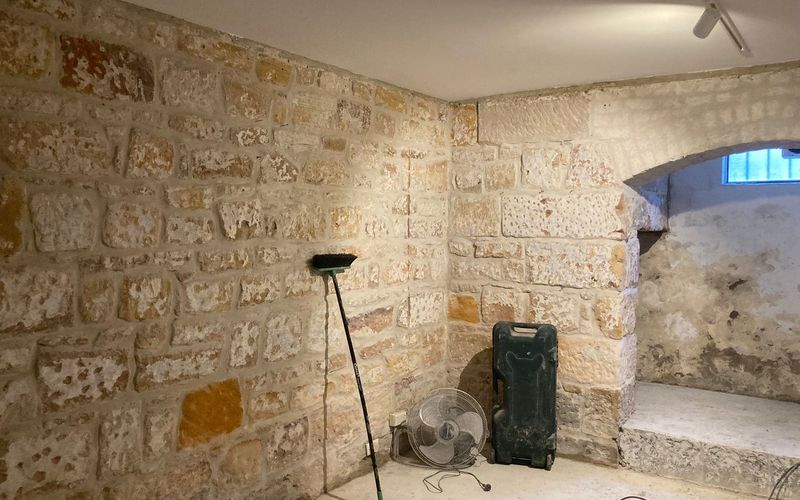
Removing paint from sandstone safely begins with an assessment of the paint, the stone and its condition, followed by a trial of the proposed method on a small test panel before any broader work starts. Aggressive approaches such as high-pressure washing, abrasive blasting and harsh paint strippers can permanently scar soft Sydney sandstone, because the stone is often weaker than the paint adhering to it. Low-impact removal, planned and carried out under controlled conditions, clears the coating while preserving the original face of the stone.
Why aggressive removal scars sandstone
Much of Sydney's older building stock, from terrace frontages and boundary walls to monuments and church stonework, is built from locally quarried sandstone. It is a sedimentary stone: sand grains bound together by a comparatively weak natural cement, full of microscopic pores that take in and release moisture. The visible face of a weathered block also behaves differently from the material behind it, because decades of exposure form a thin surface skin that shelters the softer, more absorbent interior in much the way paint shelters a weatherboard.
Paint removal methods that rely on force or aggressive chemistry cannot tell the difference between the coating and the stone. They act on both. Three common do-it-yourself approaches show how the damage happens.
High-pressure washing
Pressure washing forces water, dissolved paint residues and loosened grime deep into the open pores of the stone. Sandstone absorbs a surprising amount of water, and everything that soaks in must eventually migrate back out, carrying dissolved salts and paint components with it. As that moisture moves it can leave stains, salt deposits and grey scum lines that are far harder to resolve than the paint ever was. At higher pressures the jet itself erodes the weathered face, cutting through the protective skin and exposing the vulnerable interior.
Abrasive blasting
Blasting removes paint by removing material, and soft sandstone gives way as readily as the coating does. The typical result is a roughened, orange-peel texture across surfaces that were once fine, opened pores that swallow water, and softened detail on mouldings, lettering and arris lines. The freshly exposed interior then weathers faster than the original face ever did. None of this can be reversed: there is no practical way to put a blasted face back on the stone.
Harsh strippers and acids
Strong caustic and acidic paint removers are designed to break coatings down quickly, and they do not spare the mineral cement that holds the sand grains together. Caustic formulations can burn sandstone, leaving brownish discolouration that persists in the pores, while acids dissolve that cement and weaken the surface grain by grain. Because the stone is porous, residues are drawn inward rather than sitting where they can be rinsed away, and they can keep reacting inside the wall long after the work appears finished.
A common thread runs through all three approaches: the damage is done in seconds and lasts as long as the building. Cleaning up afterwards does not undo it, and the repairs it forces, from indenting new stone to rebuilding lost detail, cost far more than a patient removal would have. That is the case for slowing down and testing first.
The test panel comes before the removal
No responsible contractor commits to a full programme on assumption alone. The safest way to remove paint from sandstone is to prove the method on a small area before committing the whole wall. The accepted practice is to trial the candidate methods on a representative and relatively unobtrusive patch of the actual stone before the main work is scheduled. In outline, the process runs as follows.
- A trial area is selected that covers the range of paint layers and stone conditions present on the job.
- The candidate methods are applied to separate patches within that area, each under controlled conditions.
- The patches are allowed to dry fully, then assessed, because sandstone can present well while damp and only reveal staining, residue or erosion once dry.
- Where the programme allows, the patches are checked again after a period of weathering.
- The method that clears the coating without harming the stone is documented and adopted as the benchmark for the wider programme.
The test panel protects everyone involved. It shows in advance, and on the real stone, exactly what a given method will do, and it gives the owner the chance to see and agree to the resulting finish before a whole elevation is treated. On heritage items the recorded trial also supports discussions with the consent authority, because it demonstrates a controlled, evidence-based approach rather than a hopeful one.
Low-impact method families
There is no single paint removal method that suits every sandstone substrate. The approach is selected after the assessment and confirmed by the test panel, and on layered coatings it is usually a staged combination rather than a single technique. The families below describe how controlled removal works in principle; they are not a recipe for a do-it-yourself attempt, which is precisely the sort of untested approach this article is written to discourage.
Softening and lifting
Many controlled removals work by softening the paint so that it releases from the stone with minimal force. Poultice and gel systems hold softening agents against the coating for a controlled dwell period, and the paint is drawn into the medium as it loosens. The coating is then lifted away together with much of its residue, rather than being flushed or ground into the stone.

Low-pressure water and steam
Where the coating responds to moisture or gentle warmth, low-pressure water and steam methods can lift it gradually. Water is introduced at volumes and pressures the stone has been shown to tolerate, and runoff is captured rather than allowed to soak into the wall or drain across adjacent surfaces. These methods suit permeable paints and limewash in particular, and their intensity can be adjusted as the trial results dictate.
Careful manual reduction
Residual paint held in pores, and paint sitting on delicate carving, is generally addressed with careful hand methods worked to the tolerance of the stone. Manual reduction is slow and labour-intensive, which is exactly why it is reserved for the places where the stone is least able to protect itself. The work stops when the paint stops, not when the surface has been made smooth.
Staged and combined programmes
Heavily layered paint usually calls for a sequence: one method to break the bulk of the coating, a second to reduce residues, and hand finishing where detail is at risk. Each stage is checked against the test panel benchmark before the next begins. Throughout the programme, dust, debris and runoff are contained and captured, surrounding surfaces and planting are protected, and waste is handled according to what the paint is found to contain.
Paint and stone condition drive the decision
What the paint is
Paints differ in how they adhere and how they respond to removal. Limewash and soft distempers sit near the surface and often respond to gentle moisture methods. Oil-based paints from earlier eras form harder, more brittle films that bond tightly to the pore structure. Modern acrylics are more flexible and behave differently again, and a wall that has been redecorated many times may carry several distinct layers, each calling for its own approach.
Paint applied in earlier decades can also contain lead. Where older layers are suspected, the coating is tested as part of the assessment, and removal is planned with the containment, protection and waste handling that lead-bearing coatings call for. This is one of several reasons the work is planned rather than improvised, and why a casual weekend attempt is a poor match for older stone buildings.
What condition the stone is in
The stone itself shapes the method as much as the paint does. Blocks laid face-bedded expose their natural layering to the weather and resist it well, while edge-bedded blocks tend to delaminate along those layers and are far more fragile under any treatment. Surfaces may already show sugaring, where grains crumble to the touch, along with salt activity, rising damp or earlier repairs in mismatched mortars. A wall in that condition may need stabilisation before paint removal is safe to attempt at all, and the assessment determines that in advance rather than discovering it partway through the job.
When the paint should stay
Paint is not automatically the enemy of sandstone. On some walls the coating acts as a sacrificial barrier, taking the weathering that would otherwise reach the stone, and limewash in particular was traditionally maintained for exactly this reason. Removing a sound, compatible coating can expose stone that has been sheltered all along and is not prepared to face the weather directly.
The question the assessment answers is whether the paint is causing harm, by trapping moisture against the wall, concealing active decay or interfering with needed repairs, or whether it is quietly doing useful work. Leaving sound paint in place, partial removal, and redecoration in a compatible coating are all legitimate outcomes of a proper assessment. Removal is a means of protecting the stone, not an end in itself.
Aftercare and the sealing question
Once the paint is off, the stone still needs attention. Residues are reduced with gentle cleaning methods matched to the substrate, following the same assessment-led logic as the removal itself; the general approach is covered in effective techniques for sandstone cleaning. The surface is then monitored as it dries and settles, because pores that held paint for a long time can release residual staining for a while afterwards.
Sealing is a separate decision, not an automatic final step. Sandstone manages moisture by breathing, and a poorly matched coating can trap that moisture inside and cause the very decay the paint removal was meant to avoid. Whether to apply anything at all is weighed after the stone has stabilised, with conservation advice and, on heritage items, the requirements of the consent authority in mind.
Assessment-led removal as a service
This is the shape of professional involvement: the paint and substrate are assessed, the trial is carried out and documented, the method is fixed, and the removal proceeds under containment with the stone checked at each stage. Stoneline Heritage carries out this kind of controlled work through its sandstone cleaning service in Sydney, from single facades to boundary walls and monuments.
Removal frequently reveals what paint was hiding: eroded faces, open joints, delaminating scales and failed repairs. Where that is the case, repair follows cleaning rather than being blended into it, as discussed in sandstone restoration and repair in Sydney. Stoneline's sandstone restoration service covers the making-good side of that sequence, from indent repairs to repointing in matched mortars.
Approvals sit outside the masonry work itself. Whether consent is needed depends on the listing type and the local council area, and on whether the item is listed locally or on the state register. In general terms, questions go first to the council's heritage staff, and state-listed items involve Heritage NSW. Owners in strata schemes also work through their owners corporation before arranging works to common property.
Frequently asked questions
Can I remove paint from sandstone with a pressure washer?
Pressure washing is one of the quickest ways to damage sandstone. It drives water, dissolved paint and salts into the pores, and the jet can cut through the weathered face of the stone. Any water-based removal on this substrate is kept to pressures and volumes the stone has been shown to tolerate, verified on a test panel first.
Does removing paint from heritage sandstone need approval?
It depends on the listing and the council area. Work to a heritage item or within a conservation area commonly requires consent, and state-listed items involve Heritage NSW. Check with the relevant council before engaging a contractor; the heritage staff there can confirm which path applies.
Does old paint on sandstone contain lead?
It can. Paint from earlier eras commonly carried lead, so older layers on heritage stone are treated as suspect until tested. Where lead is present, removal is planned with containment and waste handling to suit, which is one of several reasons this work suits trained contractors rather than improvised weekends.
Will the stone look new once the paint is removed?
Not necessarily, and a factory finish is not the aim. Old paint can leave shadowing and traces in the pores that no responsible method will fully clear. The goal of controlled removal is a stable, legible surface that can be read and repaired, not a blemish-free one.
Should sandstone be sealed after paint removal?
Sealing is a separate decision rather than a default. Sandstone needs to release moisture, and an unsuited coating traps it, inviting decay. Any coating decision is made after the stone has dried and stabilised, with conservation advice.
How is the actual removal method chosen?
By assessment and trial. The paint type, the number of layers, the condition of the stone and the exposure of the wall are assessed, the candidate methods are trialled on a test panel, and the approach that clears the coating without harming the substrate is documented and followed for the full programme.