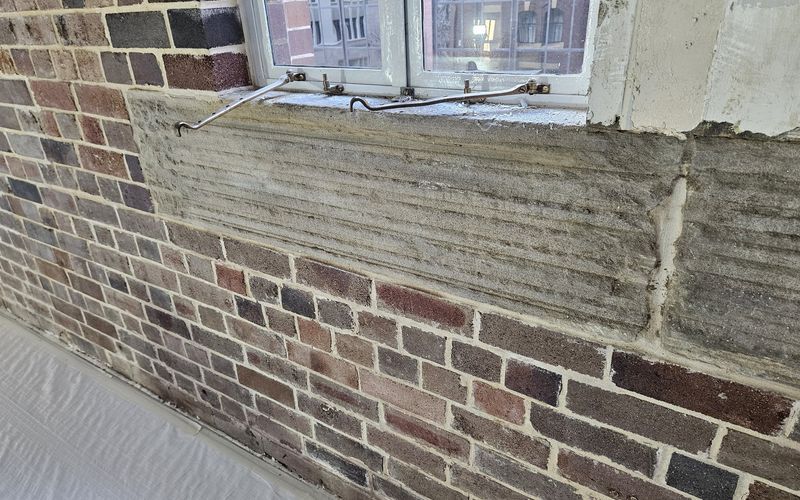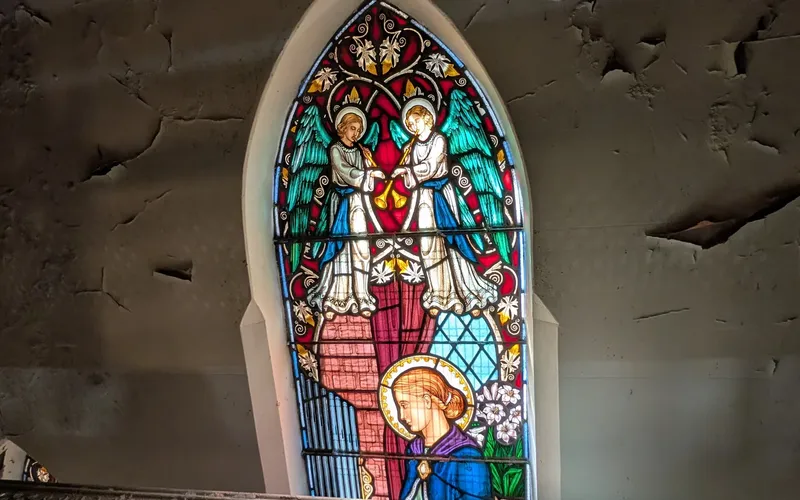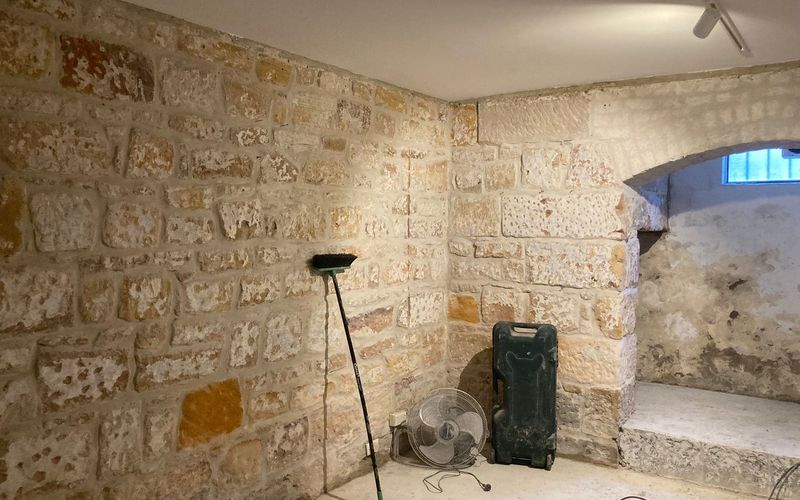
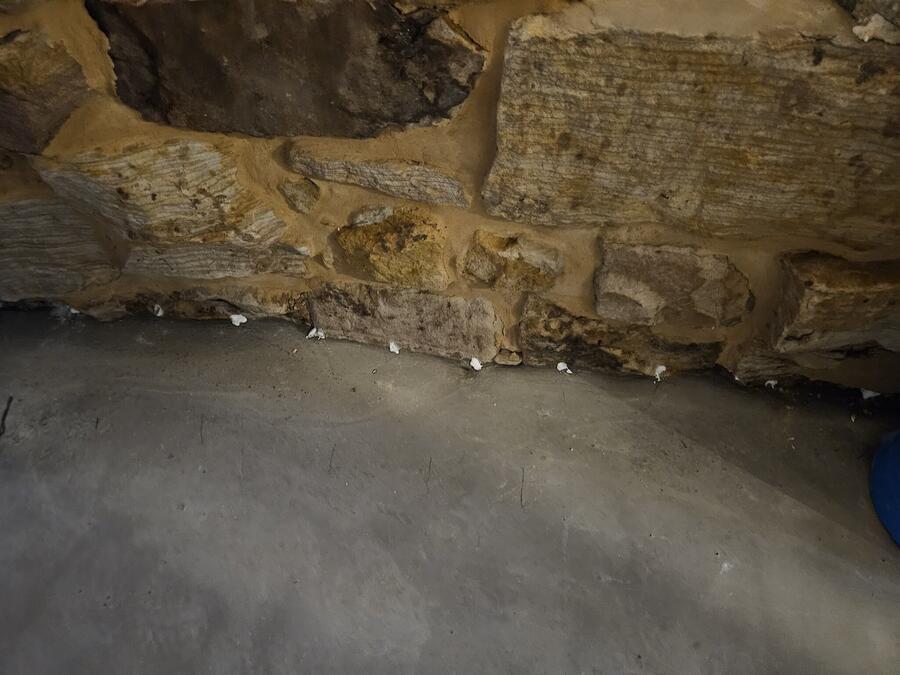
People asking how much sandstone restoration costs in Sydney are usually looking for a single square-metre rate. That number would hide more than it tells. Two elevations of similar area can need entirely different work: one a careful clean and lime mortar repair on sound fabric, the other desalination, indenting, and replacement of units that cannot be retained.
Condition of the stone and the philosophy of the repair drive the work as much as wall area. A useful quote sets those differences out element by element. Comparing a price alone fails for that reason — the same point as in our heritage masonry restoration quote checklist.
Access and protection
Access on heritage fabric is seldom straightforward. Terraces are reached through narrow side passages, parapets and chimneys sit above occupied footpaths, and garden walls adjoin planting and paving that cannot be treated as a workspace. Scaffold and access have to be designed with the fabric in mind. Where ties would land in fragile mouldings, another arrangement is needed. Where work fronts a footpath, occupancy is arranged with the council.
Protection belongs with access. The quote should describe dust and slurry containment, control of water so that runoff does not soak the wall being repaired or the neighbour's, and masking or covering of adjacent finishes. On occupied buildings it also includes hours, hoarding and keeping an entry usable. These items are how the job is done on a city building without harming the stone or the street.
Condition of the stone
Sandstone restoration in Sydney and across NSW covers weathering, salt damage, cracking and previous repairs. A weathered face that is still sound is not the same job as a cracked unit, and neither is the same as a wall already patched in cement.
Cement repairs often fail. Cement is harder and less breathable than the stone, so it traps moisture and salts and tends to accelerate decay around the repair. Lime-based compatible repairs are used instead. On old masonry the repointing mortar should be weaker and more permeable than the brick or stone it sits between, so the joint, not the masonry unit, takes the weathering. Previous incompatible repairs therefore add work: they may need to be taken out before a compatible repair can be made, and the stone around them may already be more decayed than it first appears.
Conservation prefers retaining sound original fabric. Replacement is used only where retention is no longer viable, with carefully selected matching stone. That choice — retain, indent, or replace — is made stone by stone, which is why a wall cannot honestly be priced as a uniform rate.
Salt and moisture
Where rising damp or salt drives the damage, the moisture source and salt load have to be assessed first. A surface repair on its own will fail if the cause stays active: the new repair becomes the next thing to fail.
Desalination uses poultices to draw salts out before compatible lime-based repair. That work is usually staged, not a single visit. Blanket waterproof coatings on older masonry can trap moisture and worsen damage. Protective treatments, where they are used, are selected wall by wall. Specialist silane- and siloxane-based water repellents may reduce water ingress while keeping the stone's breathability.
This is why a salt-affected base cannot be treated as a simple patch. Lasting results need the cause addressed with the stone — the same approach set out on salt damage, rising damp and desalination.
The mix of methods
A sandstone restoration scope is a mix of methods, not one process applied to every face. After assessment the work may include stone cleaning; graffiti and paint removal; stone consolidation; cavity repairs; Dutchman (stone indent) repairs; lime mortar repairs; hydrophobisation; and protective treatments.
Cleaning methods are selected by the type, condition and significance of the stone: specialist chemical cleaning, peel-off systems, and low-impact conservation techniques, chosen to minimise intervention. Cleaning is not a cosmetic reset. It is the removal of soiling the stone can tolerate.
Consolidation, cavity repairs and Dutchman indents keep original fabric in place where it is still sound. Lime mortar repairs replace failed or incompatible joints with a mix matched in strength, porosity and appearance. Replacement is the last step, not the first: only where retention is no longer viable, using matching stone selected for the building.
Stoneline's published project types include heritage sandstone cleaning — for example Martin Place in the CBD — and masonry restoration, for example St Stephen's Uniting Church. Those jobs are examples of sensitive urban work: understand the substrate, select compatible materials, and preserve original fabric. They sit with other conservation work on the projects listing.
Trials and matching before full elevations
Trials and sample panels should be named as work with their own line, assessed on the building. A trial panel tests a method on the actual substrate before it is extended. A sample panel demonstrates mortar colour, joint profile and stone matching on the wall, for approval. The approved panel becomes the benchmark for the contract.
Mortar and stone matching is not a catalogue choice. How the existing stone is identified by bed, colour and weathering character, and how replacement units will be dressed to the surrounding tooling, belongs in the quote. Doing this before full elevations is how a quote's assumptions are tested. A scope that skips it asks the whole wall to proceed on assumption.
How to read the quote
A useful quote sets out scope element by element, access and protection, mortar and stone matching, trials and sample panels, exclusions, documentation, and how approvals and hidden conditions will be handled. Compare those lines. The heritage masonry restoration quote checklist walks through each heading.
For sandstone work, the starting point is an assessment of the stone and the causes of deterioration, then a method matched to that condition. The sandstone restoration service page is the place to send photographs and a short description. The reply should be a method to assess on site, not a single square-metre figure.